Revenue Strategy
How AI value selling works when the case has to hold
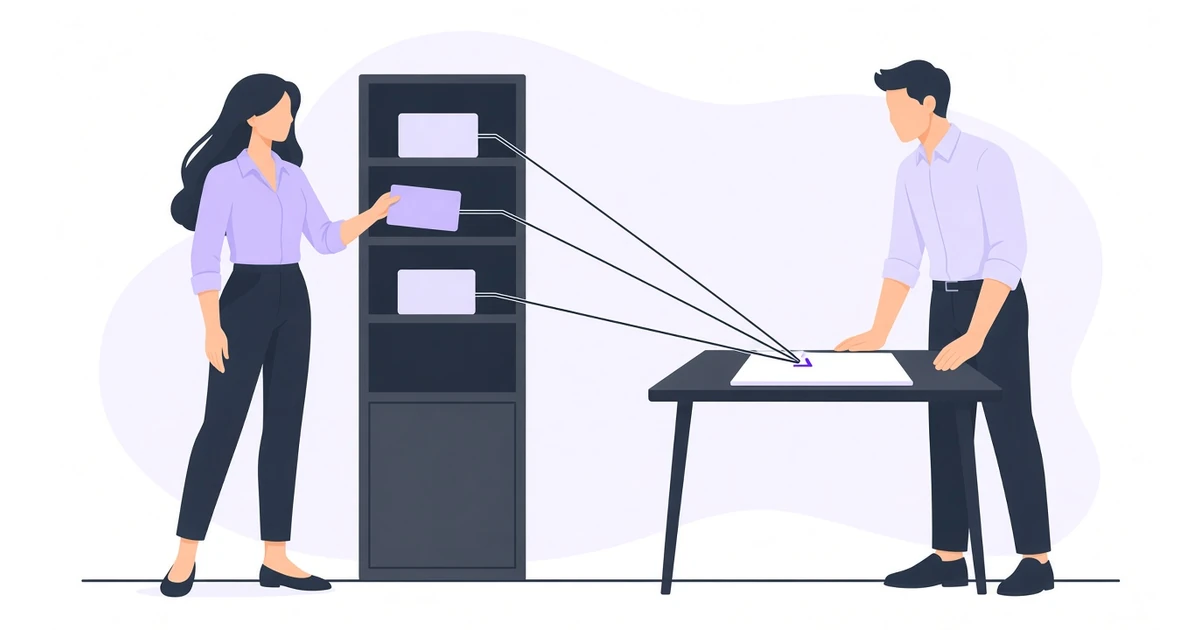
AI value selling works by keeping two piles apart. What your company already knows can be drafted from approved claims, conditions, and evidence. What only this buyer can confirm still has to be asked.
Serre, a durable value model for B2B sales teams, keeps claims a person has approved so the next deal does not start from a blank prompt. No value engineer is required, and approval is a judgment rather than a hire. The case is a projection, not a result.
Key takeaways
- 1Keep what the company already knows. Ask only for what this buyer must confirm.
- 2Approval is a judgment a person makes. It is not a hire, and it is not a new way of selling.
- 3Write one case for the group. Do not split the argument by person.
- 4Reuse carries approved reasoning forward. It does not validate a claim. Serre does not claim an effect on win rate.
74%
of B2B buyer teams demonstrate unhealthy conflict during the decision. The same survey puts the group at five to 16 people across as many as four functions. A high-quality deal in that release is buyer-reported. It is not a win rate, and it is not a cycle time.
Gartner sales survey, 632 B2B buyers, August–September 2024, published 7 May 2025
A group that size, already in conflict, does not need four versions of your argument. The same Gartner release found that content focused on individual-level relevance had a 59% negative impact on buying-group consensus, while content tailored for the group improved consensus by 20%. The 20% is that study's finding. It is not a Serre result. The practical rule is the dull one. One case, one set of figures, several readers.
AI value selling still starts from an approved claim
The first draft is the easy one. It has always been the easy one. A general-purpose model will write it from a prompt. AI value selling, in the sense that survives the second deal, is what happens to the correction.
Serre separates the piles on purpose. Most of what a case needs is knowable before the meeting: what your product changes, for whom, under what conditions, and with what evidence. Guided Discovery develops the account, persona, and solution context around the opportunity. That context is a hypothesis. Your rep tests it. Each input the buyer confirms is marked confirmed, and each one still estimated says so.
What the case stands on
Foundation at the bottom. The case on top is a projection of it, not a second model.
What the group can read
The case
- One argument
- Visible assumptions
- A projection
What only this deal knows
This buyer's inputs
- Buyer-confirmed
- Still estimated
- From the library
What your company already decided
The approved library
- Claims
- Conditions
- Evidence
Feeds back
The approved library · A correction becomes the starting point for the next case. The version a buyer already received stays as generated.
Not a new motion
Value discovery is not a new methodology. Your team already asks what the buyer is trying to change, what it is worth, and what a reviewer would accept. Serre is somewhere those answers accumulate. Nobody has to sell differently for that to be true.
What has to be approved before the case is a case
Serre drafts the structure and flags what is unsupported, stale, or in conflict. A person decides. That person can be an enablement lead, a sales manager, a product marketer, a founder, an AE, or a value engineer where you have one. The title is not the point. The point is that someone will say yes or no.
The upkeep is a review, not a project. New evidence, an item past its review, two records describing the same idea: someone looks, and either the library changes or it doesn't. Nothing enters because a paragraph sounded finished.
Reuse is not validation
Approved reasoning carries forward. Accuracy comes from the review a person does. Serre will not tell you a claim is true because an earlier case used it. Arithmetic stays deterministic either way: the same inputs produce the same result, and the narrative does not touch the sum.
Hours valued at a labor rate are a valuation of capacity, not a cash saving, until a named capture action and an owner exist. Serre does not add the operational, budget, and financial readings of one benefit into a larger total. A finance reader should be able to see that they were kept apart.
One case for the group
Turn every deal into a defensible case for change. That line is the job, not a promise about the outcome of the deal. The case is a projection the group can open. It is not a forecast of your quarter.
The loop, including who does each step, is on how Serre works. What the phrase "AI value engineer" does and does not cover is in what an AI value engineer does, and what it can't do. The questions worth asking of any tool, including this one, are in how to choose value selling software. What the generated case itself has to contain is in what business case generation for software sales has to include.
Turn every deal into a defensible case for change.
Value engineering for every seller. A person approves what enters the library.
Get Started →